Thursday, 20 June 2013

Man of Steel


Today, after a good feed at the Westbourne (Steak Fajitas* in a Tortilla basket and a pint of Gower Gold Ale) and a mandatory Joe's Ice-Cream (Strawberry Marshmallow Sundae), I had the pleasure of watching Man of Steel, the latest re-incarnation on the Superman franchise. It was film which I thoroughly enjoyed.

*See Mack's comment below!

I am not a comic aficionado and what little I know about Superman or any super hero is largely garnered from film or the odd visit to Wikipedia. I appreciate that to many, what I have to say about the film is largely irrelevant because I don't have the depth of character knowledge required to make a judgement so I offer my opinions as a casual observer. 

Without apology, My reaction to Man of Steel is largely predetermined by my childhood memories of the original Superman films with Christopher Reeve. I'm sure it's true for every generation but there are certain films which I remember watching in my youth with have stayed with me. When I watch films like Star Wars, Back to the Future, E.T. and The Goonies, it's like reliving the past, as they evoke memories of good times, family and friends. 

The Good

Man of Steel is a good film which is easy to watch and it runs along at a pace appropriate to the super hero genre. The running times feels just about right and a clever use of flashbacks at appropriate times creates a smooth and flowing narrative. Thanks to CGI, there is a far greater dichotomy between the scenes on Krypton than those on Earth compared to the previous films but I found the iconography and landscape of the former to be quite appealing. The plot is fairly simple and will be familiar to anyone who has watched the original films but it works as a tool for Clark Kent as he discovers his place in the universe as Kal-El. With that said, I do feel that as franchise starter, the plot is fundamentally flawed (A little about that later).

The casting, on the whole, seems to have been a success with particular success in the titular role as played by Henry Cavill, that of Jor-El (Russell Crowe) and their antagonist General Zod (Michael Shannon). The acting likewise is of a good standard with few superfluous characters but I feel the dialogue could have been more polished, particular in the interactions between Amy Adam's Lois Lane and Superman. I got the impression that Cavill took his role extremely seriously and was trying to squeeze everything out of the role he was given. I gained most satisfaction from the scenes between Kal-El, Jor-El and General Zog as they argue over Krypton's past, present and legacy.

The film is truly epic in scale and the action scenes are gloriously played out with the full grunt of CGI behind most scenes. For that reason, some of the fight scenes appear Playstation-esque - this is most evident in the personal combat scenes. With that flaw aside, the scale of Superman's powers is more evident because of what can be achieved with modern filmography.

The soundtrack Is suitably epic but it unsurprisingly can't live up to the original John William's score. Though the themes are not particularly memorable, I will be giving the soundtrack a second hearing on Spotify.

The Bad

Man of Steel is one of those films which, though you come away from the cinema satisfied, you are instantly aware of its flaws. This often leads to a harsher than necessary final analysis, but I think I have managed to set that aside for this film.

As I watched the film, two problems instantly came to mind. The first was the wanton destruction that Superman engaged in as he battled his nemesis (Christopher Reeve never indulged in a spot of collateral damage) and the second was very little time was devoted to why Clark Kent felt so attached to the Earth and it's inhabitants. Aside, from his parents, pretty much every other human being treats the six foot plus good looking hulk with contempt. When we finally get to see Clark Kent in glasses at The Daily Planet, he's squeezed into an ill-fitting shirt and jacket - there's no way he could be the nerdish nobody that everyone likes but largely ignores played to perfection by Christopher Reeve.

As the film ended, I found that though I had thoroughly enjoyed the epic nature of the film, I missed the playfulness of the original films. This leads me to the fundamental flaw in the film as a franchise starter - it's too epic! For me, the charm of the original films is that Superman is operating in the world in which we live. Even when his fellow Kryptonians arrive and duke it out, the world in which Christopher Reeve lives is not fundamentally altered. By the time the credits role, the Earth upon which Cavill's Superman resides is fundamentally altered, on Independence Day proportions. How can Lex Luther possibly live up to that?

Had the film been less epic, we would have had more time for Clark to develop a camaraderie with his fellow human beings thus creating a greater bond between Superman and the world he has placed under his protection. Though I didn't appreciate it at the time (typical bloke reaction, I know), there is very little chemistry between Superman and Lois Lane. For my money, Lois finds out Clark Kent's true identity far too early and this spoils the opportunity to have fun with the meme as the original films did to aplomb.

The Ugly

Thankfully, aside from the odd canine in peril (he survives), there aren't any truly ugly scenes in the film. I do question Kal-El's judgement on kissing a girl with which he has little chemistry on what is effectively their first date however. The violence in the film does mean it's not suitable for younger Superman fans which will greatly disappoint my three year old nephew.

The Lens of Faith

Action films aren't known for their fine theological nuances but Man of Steel has one scene dedicated to the exploration of faith whilst the structure of Krypton society offers ample material for debate. As Kal-El is debating whether or not to turn himself over to the authorities and from there into the hands of his enemies, he seeks the advice of a priest. The priest, tending to an empty church seemingly devoid of faith, counsels a conflicted Kal-El, who sits in front of a stained glass window of Christ in the garden of Gethsemene. As Kal-El leaves, the priest advises him that sometimes a leap of faith is necessary before trust is established. As Christ, the only Son of God was delivered into the hands of death so save us all from sin and death, so Kal-El, the only son of Jor-El, is delivered into the hands of General Zod to save the Earth.

The primary issue that a cursory analysis of Kryptonian society unveils is that of freewill. At a crucial stage of its development, Krypton introduces artificial population control - as a result, all Kryptonian children are artificially conceived according to a grand "codex" which produces the right balance of scientists, warriors, governors etc to optimise Kryptonian society.  As such, they are predetermined creatures, so that when the last vestiges of Krypton are seemingly lost, General Zod, whose sole purpose as a warrior was to protect Krypton, accuses Kal-El of taking his soul. This naturally raises the question - to what degree is Zod culpable for his actions? Is he a victim of his own society? By contrast, Kal-El, as the first child born naturally on Krypton for tens of thousands of years, is in full possession of freewill. He can choose whether to be a force for good or for evil and his decision to choose good is therefore of greater merit.

Conclusion

Man of Steel is a well worth a cinema visit. It is suitably epic and entertaining but lacks the true depth of character and humour which made the originals a childhood favourite. Cavill is an able Superman but judgement has to be reserved on his Clark Kent credentials.

Rating 75/100

Scale of Ali-G to Star Wars: X-Men 2

Monday, 17 June 2013

Bless Me Father For I Have Sinned....

Though each of the Sacraments can be said to equal in value, sharing as they do in the unity of God's plan of salvation for mankind, it is recognised that primary of place is to be given to the Eucharist which is after all the source and summit of the Church's mission. With that said, it is still possible for believers to have favourite Sacraments, often corresponding with different stages of the Spiritual Life. Since my teenage years, I have always had a particular appreciation for the Sacrament of Confession, which, over the years, has becoming an increasing source of consolation for me as I make my pilgrim way through this life.

Give a Little Whistle

One of the great graces I appear to have had bestowed on me, whether I like it or not, is a well informed conscience (plus I suspect a rather busy guardian angel). In the western world where recognising the existence of sin has become unfashionable, the concept of guilt has become a modern pariah. Much is made of the damage that guilt does to the human psyche with special vehemence and ridicule reserved for "Catholic Guilt", that unique brand of guilt fostered by repressive Church teachings and sadistic nuns. Some catechists may over emphasise the terrors of the Fires of Hell and relish describing the horrific torments that await the unrepentant sinner to their own detriment but authentic Christian teaching on sin and guilt should fill us with hope.

For me, the ability to discern right from wrong is one of the defining characteristics of the human person and it is a life's work. "The education of the conscience is a lifelong task... prudent education teaches virtue; it prevents or cures fear, selfishness and pride, resentment arising from guilt, and feelings of complacency... The education of the conscience guarantees freedom and engenders peace of heart". [1] True freedom exists not in licentiousness and doing whatever one wants but rather being unfettered in doing what is right. The fact that we sin shows that we are not truly free because if we were, we would always choose to do good. In essence, we are "slaves to sin". [2]

Far from being an agent of repression, guilt serves an essential role - it is part of the feedback mechanism which helps us recognise that we have fallen and that we need to get back up. True, if left unchecked, guilt can destroy the human spirit but we have not been abandoned to guilt by God. Rather, through the death and resurrection of his Son and in the Sacrament of Confession, we have been given a remedy which far surpasses our fall. Indeed, the Easter Exultet goes so far as to proclaim :

"O happy fault,
O necessary sin of Adam,
which gained for us so great a Redeemer!"

whilst in "Praise to the Holiest in the height",  John Henry Newman as saw fit to write :

"O loving wisdom of our God!
When all was sin and shame,
a second Adam to the fight
and to the rescue came."

(Those lines always gives me goosebumps)

I always remember being told that a good rule of thumb was to go to confession once a month but I now tend to go whenever I feel I need to. Sometimes, there can be several months between visits, sometimes only a few days. I have made a habit of going to confession before making a long journey - it's the best form of travel insurance on the market and can't be found on any comparison websites, even those operated by Meerkats.

With Great Power Comes Great Responsibility

The tricky thing about conscience is that the better informed it is, the more responsible the individual becomes for the consequences of their actions. The greater one grows in knowledge and understanding and the deeper one's love of God becomes, the graver the effects of one's sins, both in guilt and consequence. Ignorance is certainly not bliss in this regard but planks and splinters often come to my mind when I am tempted to pour invective onto behaviour which displeases me amongst the public at large. 

Of all the Sacraments of the Church, Confession appears to be the most underused. This may be a reflection of the general shying away from recognising the existence of sin in society in general but I suspect it also has much to do with the unavailability of priests, a paucity of good catechesis and a fear of what the priest may think of the penitent (itself a result of poor catechesis). We need a new generation of great confessors like St Jean Vianny and St Padre Pio to rectify this grave shortcoming in the spiritual life of so many. Confession, like Mass, should be available daily in every deanery in the morning and evening, in every diocese in the world. If you want to know more about Confession, try and get hold of a copy of Confession: The Forgotten Sacrament, or check out some of the material available from CTS.

Yo! Adrian, We Did It

The church teaches us that the Sacrament of Confession obtains forgiveness from God and achieves reconciliation with with the Church and society. Its benefits are not limited to the spiritual domain, extending as it does to individual psychological and emotional wellbeing and personal relationships. I was once told by an Psychologist who was consulting on a court case that though he had no spiritual convictions whatsoever, he thought confession was a practice which the whole of society could benefit from, if only for it's cathartic value. It really is a wonderful feeling as you emerge from the confessional having removed the monkey (or meerkat) from your shoulder.

One of the greatest spiritual difficulties I have to admit to facing is dealing with habitual sins - those sins so long entrenched that they have become fixed behaviours. With Saint Paul I have to admit, sometimes in anguish, that the things I do not wish to do I always end up doing. [3] Much is made of the fact that God will never tire of forgiving us and for this we must be extremely grateful. The problem for many however is not that God will tire of forgiving our sins but that we will tire of asking for forgiveness. The soul who reaches this state is in great peril indeed. It is all too easy to wallow in our sin and think about throwing in the towel but as Rocky says,  "it ain't about how hard you hit, it is about how hard you can get hit and keep moving forward, how much can you take and keep moving forward. That's how winning is done! [4]

Act of Contrition

O Lord, upon Your altar of expiation, I offer You all the sins and offenses I have committed in Your presence and in the presence of Your holy angels, from the day when I first could sin until this hour, that You may burn and consume them all in the fire of Your love, that You may wipe away their every stain, cleanse my conscience of every fault, and restore to me Your grace which I lost in sin by granting full pardon for all and receiving me mercifully with the kiss of peace. [5]

[1] The Catechism of the Catholic Church, 1784 
[2] Romans, 7:14
[3] Romans, 7:15
[4] Rocky Balboa
[5] The Imitation of Christ, Thomas a Kempis

Thursday, 13 June 2013

Cause I Gotta Have Faith (Schools)

Stephen Fry Up

Following Stephen Fry on Twitter can be quite exasperating. Most of his Tweets either ridicule my beliefs or take positions diametrically opposed to my own. Why then do I continue to follow him? I think it's because If you stop engaging with people with different views to yourself, you stop growing as a person and you may find that the ultimate casualty is your own beliefs as they decay through atrophy. That, and I do like his sense of humour.

Faithless Admissions


One of Mr Fry's most recent wind up tweets was his support for the "Fair Admissions" Campaign [1] which aims to "open up all state-funded schools to all children, without regard to religion", asking the following questions:

"Are you facing the prospect of your child being unable to gain admittance to your local school, because of religious selection?"
"Or have you had to game the system in order to get them in?"
"Are you happy to live in a society in which children are discriminated against on these grounds, while parents feel compelled to behave in this manner?"

The campaign is supported by the usual suspects like The British Humanist Society but is also curiously endorsed by Rt Revd John Pritchard, Bishop of Oxford, The Diocese of London and The Methodist Church of Great Britain.

ReligousIntolerance.org

The Fair Admissions websites suggests that it is not the religious "ethos" which makes some faith schools perform better, but their selectivity, which is taken advantage of by more articulate, better off, parents. I have little doubt that this does take place but it is fallacious to suggest that the problem is is limited to Faith schools. Indeed, a purely secular state system of education will effectively discriminate against less affluent families who cannot afford to send their children to private schools.

The campaign "Faith Admissions" is misnomer- if it succeeds, by processes of attrition and dilution, Faith schools will cease to exist because they will be populated by children whose parents will unsympathetic to the original ethos. One of the main reasons parents want to enrol their children into these schools is that they have good reputations and there is much to suggest that the unifying characteristics of a shared Faith creates an environment in which children feel valued,confident and able to succeed. If this ethos is eroded then they risk lowering standards. As a friend has suggested, the banner of "fair admissions" hides the true agenda, which is to drive religion out of public life entirely.

Render Under to Caesar

Those who support the campaign (especially those of a religious disposition) may genuinely believe that a Faith school education does more harm than good, perhaps on the grounds that a mix of opinions will foster greater debate and more tolerance. Of course, others will go further and suggest that Faith Schools are breeding grounds for intolerant brain washing.

During an exchange on Facebook, one keen observer suggested that the state had the right and duty to decide the rules and conditions under which public funds are given out and used, and it had been doing so for schools ever since it started funding them in the nineteenth century. This may be so but the right and duty of the state to educate is only afforded because the state represents the people and can arrange education with public funds. Parents have a right and duty to educate their children as they see fit and it is not the state's place to interfere with that right. As tax payers, they also have the right to have the type of schools that they want for their children. The state establishes schools to facilitate and vindicate the rights of parents, not to abrogate them.

The Faithful Remnant 

Like many of the issues affecting the Faith today, this issue has only developed any momentum because common religious ground is being removed from the public sphere. One the one hand, the inexorable juggernaut of aggressive secularism continues to progress unabated and on the other, the number of practising faithful continues to decline. In this, we really are reaping what we sow. Still, even the faithful remnant have a right to educate their children as they see fit.

[1]  http://fairadmissions.org.uk/

Tuesday, 4 June 2013

On the quality of the paving slabs of the Red Light District of Amsterdam

Whenever I am thrust into new friendship groups for any length of time, the nature of my Faith is usually one of the first topics which attracts a lengthy discussion. Though I may dare to hope that this is due to the excellent character of my witness, I suspect it is more to do with the novelty of the answers I give to everyday questions and scenarios. The topic which sparks off the most interest, particularly and perhaps predictably amongst men, is sex. Having recently survived two stag parties and several interrogations, I have recently been given plenty of opportunities to express my opinions.

Sex Bomb

The nature of the discussion (at least with men), usually follows a predictable pattern. I decline to acquiesce to what has become an acceptable norm for the modern man (commenting on a particular woman in a sexual manner, looking at page three, discussing pornography or sexual exploits etc) and am then subjected to an interrogation regarding my views on sex and on my sexual experience and activity, largely from a derisive point of view. The ultimate conclusion invariably is that I must be gay.

Some commentators may understand the concept of saving sex until marriage [1] (though dismiss it as a quaint Christian practice) but few are able to contemplate a single life without compensating sexual practices such viewing pornography or masterbation. After enduring many of these these discussions, I have come to the realisation that modern man is actually a slave to what is he is told is the sexual norm - sexuality is to be expressed where and when desired, subject only to the law of "consenting adults".

Image and Likeness

Sexual identity and the sexual appetite are undeniable facets of human existence. Indeed, the Church teaches that they are good, even great things. "Everyone, man and woman, should acknowledge and accept his sexual identity... The harmony of the couple and of society depends in part on the way in which the complementarity, needs, and mutual support between the sexes are lived out." [2] Indeed, in a mysterious way, in the division of humanity into male and female we are made in the image of God and given a unique vocation with the capacity and responsibility for love and communion which is itself a reflection of the personal loving communion which exists between the three persons of the Trinity. "The union of man and woman in marriage is a way of imitating in the flesh the Creator's generosity and fecundity". [3]

Masturbation, viewing pornography and engaging in other sexual practices cannot therefore be a natural end point of this appetite because they do not promote a communion of love - they are inherently selfish acts. In reality, they are addictive, acquired behaviours which become habitual to such a degree that it seems impossible for some to live without them. Though differing wildly in degree, masterbation is akin to biting one's nails, though I suspect the former has greater spiritual consequences than the latter.

Control, control! You must learn control!

A useful angle on the topic was afforded to me as I read "Difficulties in Mental Prayer" by Fr Eugene Boyle. In discussing prayer, Fr Boyle makes a distinction between feelings which arise out of the senses (sorrow, joy, elation etc) perhaps provoked by a beautiful church or a picture of the crucified Christ and those which arise from the intellect and the will. Man possess a sense appetite which desires any good or attractive object set before the senses, either in reality or through imagination. This facility is automatic and is traditionally referred to as a passion by philosophers. This desire is outside of the will and it is only when the will recognises the object and chooses to desire it that a moral choice is made. In other words, temptation is not a sin, nor does it demand that man give into it. The intellect and the will have the final say.

Some of my closer non-Catholic friends have told me that they admire my "control" with regards to not indulging in any sexual activity. Chastity is regarded by the Church both as a moral virtue, the mastery of the senses by the intellect and will, and a grace, a fruit of spiritual effort. [4] This certainly has a massive part to play in what is rightly regarded as a position of temptation but I suspect that my burden is far less than their own simply because I am not weighted by their habitual behaviours. Indeed, pastoral guidelines on offenses against chastity recognises this fact. [5]

Things to do in Amsterdam when you're Catholic


Paradoxically, it is often the most overt temptation that is easier to resist. I found it a lot easier to acquaint myself with the excellent paving slabs of the Red Light District of Amsterdam when walking between pubs than I find it to guard my thoughts on a particularly nice summer's day. I am often asked "How I do it?", namely not lust after women and the answer I give is "I try and follow the advice of a good priest - 'Whenever I see a beautiful lady, I thank God for his creation, and move on'". In essence, the sense appetite is presented by a good (an attractive lady), the will consents to the goodness of this thing in the created order but declines the opportunity to regard and internalise it in a sexual manner.

Chastity has real benefits and perhaps the most obvious is friendship. I suspect many of my friends are unable to have meaningful, non-sexual relationships with members of the opposite sex largely because they are preconditioned to regard them in a sexual manner. Again, the Church teaches that "chastity blossoms in friendships", allowing us to imitate Christ who has chosen us as his friends. [6]

A failure to communicate

This leads me onto the final fallacy of the conversation, a classic false dichotomy, that failure to express the normative sexual behaviour for a heterosexual man must necessitate what is regarded as its opposite - homosexual behaviour. Though one mighty churlishly suggest that such an attitude is indicative of a mindset which fails to understand a concept, preferring to ascribes a derisory antithesis to it in order to maintain a particular world view, it demonstrates that the notion of chastity really has lost all resonance with the society in which we live.

Of course, none of this suggests that chastity it easy. It is a life's work which must constantly be reinforced with self-renewal, dedication and prayer. Contrary to modern thinking, it is not however impossible and certainly not irrelevant.

Prayer for Chastity

O my God, teach me to love others with the purity of Your holy Mother. Give me the grace to resist firmly every temptation to impure thoughts, words or actions. Teach me always to love with generosity and goodness, to respect myself and others in the way I act and to reverence the way that You have given us for the creation of new life

[1] Reducing the Church's teaching on human sexuality to the concept of "saving sex until marriage" does it a terrible disservice. The focus should not be on abstinence but rather on living a continually chaste life. Arleen Spenceley writes very well on the topic at http://www.arleenspenceley.com and specifically at http://www.arleenspenceley.com/2012/09/i-am-not-saving-myself-for-marriage-im.html

[2] Catechism of the Catholic Church, 2333

[3] Catechism of the Catholic Church, 2335

[4] Catechism of the Catholic Church, 2345

[5] Catechism of the Catholic Church, 2352

[6] Catechism of the Catholic Church, 2347

Monday, 20 May 2013

Wanted!

Candidates are required for positions of great importance within a venerable international institution. Duties include, but are not limited to:

Accountancy, Advocacy, Bereavement Counselling, Charity Work, Childcare, Community Outreach, Conflict Resolution, Elderly Care, Event Management, Expedition Management, Facilities Management, Fund Raising, Gardening, Healthcare, Public Speaking, Relationship Counselling, Teaching, Transportation, Warfare, Wedding Planning

Salary starts at £0 and is expected to rise to £0 upon death. Hours will not exceed 24 hours per day, 7 days a week and candidates are expected to be on call at all times. Training will last for 7 years and may involve international travel.

Position Title: Catholic Priest

Mission: Impossible?


A few weeks ago, it was Vocations Sunday - a day dedicated to promoting and praying for vocations to the priesthood, deaconate and religious life. It has always been the duty of parish and diocese to foster vocations, but given the apparent death of candidates in the western world, Vocations Sunday has been introduced to give higher priority to the cause. If looked at from the secular view point of an occupation, being a Catholic Priest or Religious is a thankless task, possibly beyond the bounds of human endurance. Individuals may be attracted to the position by the opportunity for study and possibility of serving their  community but the long hours, lack of pay, requirement for celibacy and spiritual focus put it at odds with the modern mindset.Though it was formerly a well respected position throughout most of Europe, Catholic priests are today often met with ridicule, misunderstanding or outright hostility outside of their own parishes (and sometimes within!).

London Rome Calling

The key to the Catholic understanding of the priesthood and the religious life can be found in the term "vocation" which derives from the latin "vocationem" which means "calling". A vocation is calling from God whereby "interior and exterior helps, the efficacious graces which have led to the taking of the resolution, and all the graces which produce meritorious perseverance". [1] The church also teaches that vocation is revealed by deliberation according to Faith and Reason (and sometimes by supernatural insight). In short, a vocation cannot be undertaken by earthly means alone - it can only be entered into and maintained by grace. "With men this is impossible: but with God all things are possible". [2]

With great power comes great responsibility

Becoming a priest in the Catholic Church is an an undertaking of the utmost responsibility and gravity. Though all the faithful are called to share in the priesthood of Christ, a priest acts "in personna Christi", in the person of Christ, acting in service of the common priesthood as a means to build up and lead the church. Such is the awesomeness of this undertaking, the church teaches that following their ordination, an ontological change takes place in the candidate - they emerge as a new being, something that they were not before. "Priests are consecrated in order to preach the Gospel and shepherd the faithful as well as to celebrate divine worship" and  in the "sacrifice of the Mass they make present again and apply, until the coming of the Lord, the unique sacrifice of the New Testament, that namely of Christ offering himself once for all a spotless victim to the Father". [3] As St. Maximilian Kolbe said, "If angels could be jealous of men, they would be so for one reason: Holy Communion", and it is through the priest that this is made possible.

The Good, The Bad & The Ugly

If priests are possessed of such dignity and power, why are some of them so sinful? Recent church scandal and a long history of the worst kind of ecclesiastical abuse would seem to cause irreparable damage to the Church's claims for the priesthood. Indeed, there is little denying that like the whole of the Church, the order of priests is a melting pot of Saints, Sinners, the indifferent and the lukewarm.

That priests struggle to live the life of Christian perfection like the rest of us should not surprise us, nor cause us undo scandal. Of the men Christ personally chose to follow him, one betrayed him to death, one denied that he knew him three times and the rest abandoned him in fear of their lives. Though priests share in the priesthood of Christ, they do not have dominion over Christ nor are they afforded inalienable supernatural powers akin to a superhero. The term the Church uses to explain this is "Ex opere operato" - the sacraments confer grace not as the result of activity on the part of the priest or the recipient but by the power and promise of God. A priest might be in mortal sin but that does not affect God's ability to work through him. [4] 

Sexism and Celibacy

Two major issues immediately come to mind in the public sphere when the topic of the priesthood - that of female priests and celibacy. To understand each, one must try to understand the nature of the Church. Catholic theology divides the functions of the teaching office of the Church into two categories: the infallible sacred magisterium and the fallible ordinary magisterium. The infallible sacred magisterium includes infallible papal pronouncements like Pope Pius IX's definition of the Immaculate Conception of Mary, The Fourth Lateran Council's declaration on Transubstantiation and the the common teachings of the Church as understood from Scripture and Sacred Tradition. The ordinary magisterium includes potentially fallible teachings and the authority necessary for church goverance.

The issue of Female Priests falls under the providence of the infallible sacred magisterium and as such, the Church has no authority to change it's position. This position was confirmed by Pope John Paul II's encyclical Ordinatio Sacerdotalis which summarises the reasons for the Church's position as follows:

"The Gospels and the Acts of the Apostles attest that this call was made in accordance with God's eternal plan; Christ chose those whom he willed (cf. Mk 3:13-14; Jn 6:70), and he did so in union with the Father, "through the Holy Spirit" (Acts 1:2), after having spent the night in prayer (cf. Lk 6:12). Therefore, in granting admission to the ministerial priesthood, the Church has always acknowledged as a perennial norm her Lord's way of acting in choosing the twelve men whom he made the foundation of his Church (cf. Rv 21:14). These men did not in fact receive only a function which could thereafter be exercised by any member of the Church; rather they were specifically and intimately associated in the mission of the Incarnate Word himself (cf. Mt 10:1, 7-8; 28:16-20; Mk 3:13-16; 16:14-15). The Apostles did the same when they chose fellow workers who would succeed them in their ministry. Also included in this choice were those who, throughout the time of the Church, would carry on the Apostles' mission of representing Christ the Lord and Redeemer.

Furthermore, the fact that the Blessed Virgin Mary, Mother of God and Mother of the Church, received neither the mission proper to the Apostles nor the ministerial priesthood clearly shows that the non-admission of women to priestly ordination cannot mean that women are of lesser dignity, nor can it be construed as discrimination against them. Rather, it is to be seen as the faithful observance of a plan to be ascribed to the wisdom of the Lord of the universe."[5]

By contrast, priestly celibacy is a law or discipline of the church, enacted with the aim of enabling the Church to better fulfil it's mission. As such, the law of celibacy is subject to change and, in extenuating circumstances, for example for converts from traditions which accept married clergy, can be relaxed. Indeed, for most of the Church's early history, priests, like the apostles and disciples could and did marry. Celibacy only gradually became a universal requirement of the priesthood with a definite movement toward the practice emerging during the eleventh century as papal authority became more effective. 

Some of the arguments for priestly celibacy are historical in nature - it curbed certain ecclesiastical abuses associated with the distribution of Church funds and ensured that the patrimony of a parish was not subject to inheritance. For the most part however, the rule of celibacy is enacted in recognition of incredible demands of the priesthood which is ultimately concerned with the salvation of souls through the imitation of Christ and celebration of the sacraments.

In a society seemingly obsessed with sex and saturated with sexual imagery, the concept of celibacy and chastity is met with incredulity, consternation and ridicule. Some, paradoxically, claim it is at the root of the clerical abuse scandal, repugnantly suggesting that should men with paedophile tendencies be allowed to marry, they would have a legitimate outlet to their "frustrations" or "impulses". Opinions such of these betray a complete lack of understanding of the nature of consecrated celibacy and afford a penurious view of reason's ability to rise above inclination and disordered desire.

Like the priesthood and religious life, celibacy can only be understood in terms of vocation, service and sacrifice. Practically, it would be exceedingly difficult to fulfil the role of priest and husband and father, perhaps to the detriment of both. By focusing on the imitation of Christ, priests are "called to consecrate themselves with undivided heart to the Lord and to 'the affairs of the Lord,'... they give themselves entirely to God and to men". [6] In making the sacrifices required to live a life of celibacy, priests are strengthened in their vocation, recognising that as Christ the Bridegroom is wed to his Church, so they, by sharing in Christ's priesthood, are willing to give themselves up for the Church. [7]


The Incredibles

When you live in a Catholic household, in addition to stories about Superheroes, you also get stories about the Saints, many of whom happen to be priests or religious. Two of my favourite stories concern two priestly saints, St Dom Bosco and St Padre Pio. St Dom Bosco had a great concern for poor and orphaned children, setting up schools to keep them off the streets and out of the hands of organised crime. For this, his personal safety was often threatened but he never worried because his guardian angel turned into a huge black dog and chased nefarious characters away. St Padre Pio of Pietrelcina was an incredible man to whom hundreds of miracles including bilocation and stigmata are attributed. What interested me most however was his ability to read souls. Confessors would often conclude their confession only to be interrupted by Padre Pio who would coax them into remember some sin they had long forgotten.

Like every other Catholic, my experience of the priesthood and religious is as varied as the Universal Church. I have met some truly inspirational priests and religious, some saintly men and women, some who seemed indifferent or totally unsuited to their vocation but were otherwise nice people and others whom I had little time for. I have friends that have become priests and priests that have become friends. Though tasked with a divine vocation, they are all human beings, capable of greatness and ignominy. 

Prayer for Vocations


Lord,
Make me a better person,
more considerate towards others, more honest with myself, more faithful to You.
Make me generous enough to want sincerely to do your will whatever it may be.
Help me to find my future vocation in life and grant that through it I bring happiness to others and find happiness myself.
Grant, Lord, that those whom You call to enter the Priesthood or Consecrated Life may have the generosity to answer Your call, so that those who need Your help may always find it.
I ask this through Christ Our Lord, Amen.


[1] http://www.newadvent.org/cathen/15498a.htm
[2] Matthew 19:26
[3] http://www.vatican.va/archive/ccc_css/archive/catechism/p2s2c3a6.htm
[4] http://www.catholic.com/quickquestions/what-does-the-expression-ex-opere-operato-mean
[5] http://www.vatican.va/holy_father/john_paul_ii/apost_letters/documents/hf_jp-ii_apl_22051994_ordinatio-sacerdotalis_en.html
[6] http://www.vatican.va/archive/ccc_css/archive/catechism/p2s2c3a6.htm#1579
[7] Ephesians 5:22-33

Sunday, 14 April 2013

What does it mean to be human?

Warning - This post contains content many people will find upsetting

This week one of the biggest news items in Catholic circles was what was not making the news. Dr Kermit Gosnell is standing trial in a Philadelphia Courtroom charged with seven counts of first-degree murder yet his victims could number in their hundreds. In any other circumstances, a mass murderer would get national and possibly international coverage which would no doubt contain every lurid detail which could be garnered by the press and squeezed out of the case. What makes Dr Gosnell's case different however is that he was performing late term abortions - it is a case "about a doctor who killed babies and endangered women... he regularly and illegally delivered live, viable babies in the third trimester of pregnancy - and then murdered these newborns by severing their spinal cords with scissors". Dr Gosnell is also accused of overdosing his patients with dangerous drugs, spreading venereal disease with infected instruments, perforating wombs and bowels - and, on at least two occasions, causing their deaths." [1]

More details on the case can be found in an article which contains some graphic images by Conor Friedersdorf at http://www.theatlantic.com/national/archive/2013/04/why-dr-kermit-gosnells-trial-should-be-a-front-page-story/274944/. A summary by Kirsten Powers without graphic images can be viewed at http://www.usatoday.com/story/opinion/2013/04/10/philadelphia-abortion-clinic-horror-column/2072577/ in which she states "You don't have to oppose abortion rights to find late-term abortion abhorrent or to find the Gosnell trial eminently newsworthy. This is not about being "pro-choice" or "pro-life." It's about basic human rights."

The reasons for the failure of major news networks to report the trial which Conor Friedersdorf acknowledges to have numerous elements any one of which would normally make it a major story, clearly lies in the subject matter and what I regard as the "inconvenient truth" of abortion, namely that it places an arbitrary and subjective chronology on what it means to be human. Whether or not a baby can be legally killed could in theory be a matter of days or hours. Looking at it in another way, it could even be the thickness of a womb as babies delivered through failed abortions cannot be legally killed. The application of terms such as foetus or baby can therefore vary in application by time, space and maternal desire. Is there truly a difference between a baby delivered prematurely at 22 weeks which doctors will do everything in their power to save and a foetus removed from the womb at the same date via an abortive "procedure"?

Many of those involved in the Pro-Life cause were outraged by the media blackout on the case and sought to counteract the paucity of coverage by taking to Twitter and other forms of social media to highlight both the case itself and what they regard as a clear case of media bias. I believe that the case is in the public interest, particularly in America where it is taking place and I would hope that it's publication might gradually convince some people that abortion is not a viable solution to unwanted pregnancy and that despite the immense sacrifices and courage required, there is a better way. To this end, I dispatched a few Tweets:

This #Gosnell abortion case really sounds quite horrific :(

The #Gosnell abortion case is quite horrific - the media are afraid to report it for fear of offending liberal sensibilities

The later Tweet produced a response from a friend who thought I was implying that liberals might approve of illegal abortions and gross misconduct which I explained was not my intent. As he suggested, I don't think anyone sane could condone any of Dr Gosnell's actions. 

After we had resolved some misunderstandings, we went on to have an interesting discussion on what it meant to be human and more specifically how we define it. For him, as a Pro-Choice advocate, the issue of legality is important and he used an interesting analogy to describe his position. Law can be used to determine personhood in the same way it does when determining the alcohol limit for driving. Driving above the alcohol limit is drink-driving, while driving if you're slightly below it is not. Where a line must be drawn the law does so but morally, we can recognise a grey area between. To take this analogy further, it affords for scenarios where one individual might be over the limit and another might not having consumed the same amount of alcohol due to differences in physiology or environmental factors.

I rejected this analogy, highlighting that throughout history law has been used to denigrate & extinguish the humanity of many on the whims of a particular interest group and suggested that human life should not be a subjective concept. On this basis, I suggested that conception to death is only definition which made sense. After a brief exchange over why conception was so important and why my definition wasn't extended to eggs    we came to the heart of the debate - what makes us distinctly human?

I began by highlighted that a fertilised egg contained a unique set of human DNA and (without going into the complexity of twins etc) suggested that this had to be our starting point for the definition of human life. Every living person can trace their uniqueness back to this point. He went on to ask  that if DNA was a major part of the definition of what it was to be human, what was my opinion on chimps which share 95% of our DNA, the last common ancestor of chimps and humans, or Neanderthals? I thought this was an interesting point as he was trying to demonstrate that "being human" isn't as rigidly definable as I thought. Could a Neanderthal baby be aborted?

I have to admit that I have never really considered the topic in these terms and am not familiar with the various anthropological and socio-evolutionary factors which might be brought to bear on the debate. I have always considered a DNA analysis of human cells to be concrete but can see how other factors such as intelligence, culture, capability could be more subjective. Ultimately, I suggested these arguments did not have any baring on the abortion debate because they dealt with differences between species. Abortion deals with differentiating within our own species, largely on terms of convenience. How we would deal with "nearly human" species is a very interesting concept, but I argued that nearly human is not human. How we treat other species is nevertheless a mark of our humanity.

This exchange led to a further consequence of attempting to define what is was to be human namely that the first human would be born to technically non human parents. Despite being almost exactly the same as its parents, would that child have all the rights of a human that its parents lacked? Again, though a fascinating concept full of philosophical, theological and anthropological implications, I didn't think this directly impinged on the abortion argument as we can categorically say that any child conceived of human parents was human itself. 

So, the very heart of the argument which can explain our differences was on our choice of definition of what it is to be human. His admitted to the fuzziness at the edges, and mine did not. I was glad to have engaged in this conversation because it was amicable and informative. It has given me further angles to consider and avenues to explore. 

The astute observer will notice that at no point during the conversation did I mention that my position on abortion is underpinned by Christian Faith. I didn't think it was necessary in this instance as I believe the case against abortion can be made by purely rational argument in accordance with natural law. With that said however, I believe that the most fundamental definition of what is to be human is that we are made in the "image and likeness" of God [3]. As children of God, we share in a unique dignity and equality which surpasses all of His other creations. God says to each and every one of us "Before I formed you in the womb I knew you, before you were born I set you apart". [4] I believe that this point is further evidenced in the fact that God became man in Jesus Christ and shared in our human life, from conception in the womb of the Virgin Mary and [5] that even in the womb, His presence was felt by others [6]. 

The last thing I wish to point out on the Gosnell case is that in trying to publicise the story, Pro-life advocates should be careful not to try and use it to their advantage in the same crass manner than some Pro-Choice advocates attempted to profit from the tragic death of Savita Halappanavar. It was widely reported that Mrs Halappanavar died because she was refused an abortion at a Catholic hospital before all the facts of the case became known when in fact she died due to sepsis which went untreated for too long because of a catalogue of errors by staff at the hospital.

[1] http://www.theatlantic.com/national/archive/2013/04/why-dr-kermit-gosnells-trial-should-be-a-front-page-story/274944/

[2] http://www.usatoday.com/story/opinion/2013/04/10/philadelphia-abortion-clinic-horror-column/2072577/

[3] Gen 1:26

[4] Jer 1:5

[5] Luke 1:26-38

[6] Luke 1: 44

[7] http://carolinefarrow.com/2013/04/11/savita-sepsis-and-statistics/

Sunday, 7 April 2013

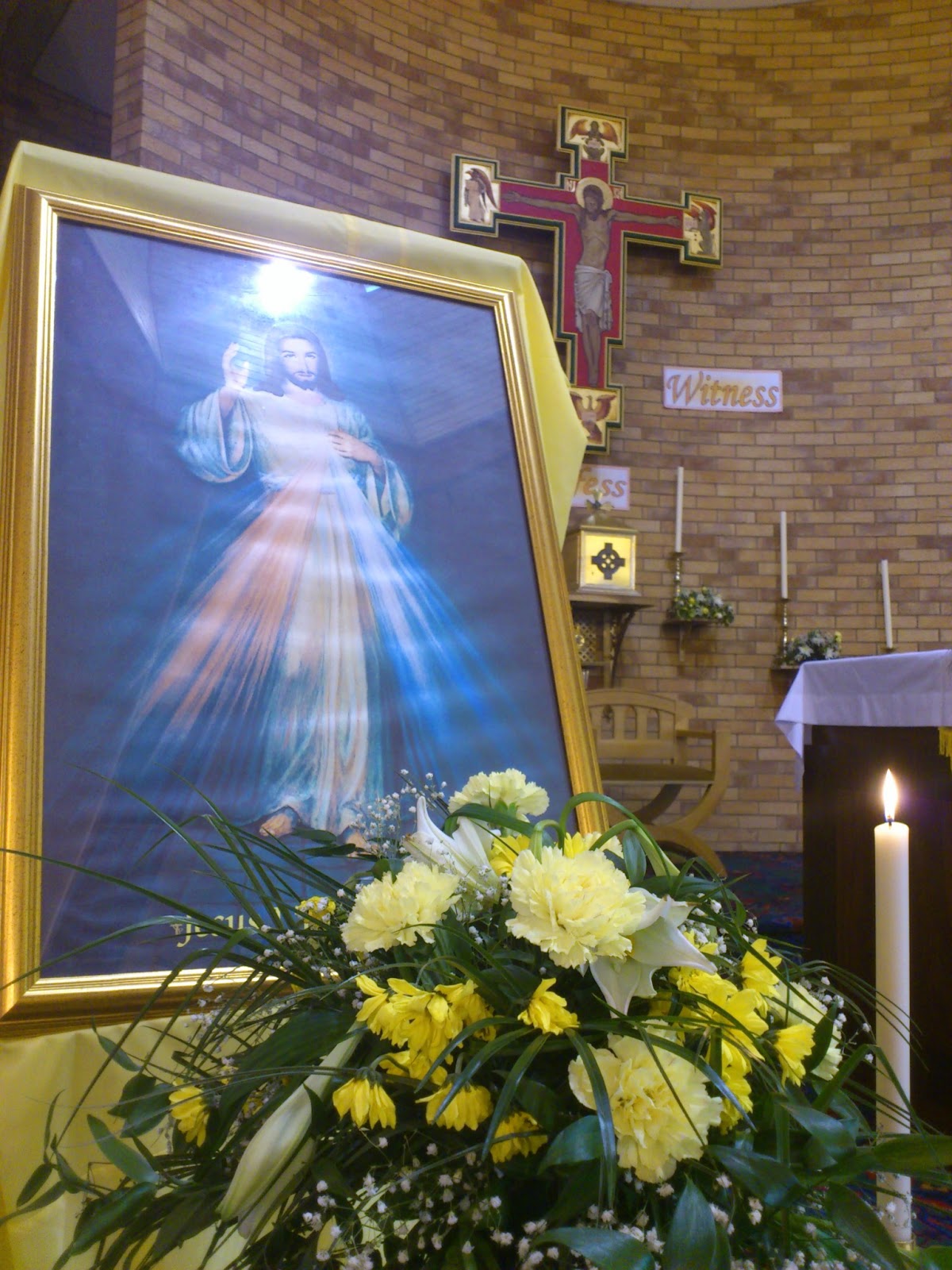
Divine Mercy Sunday

Divine Mercy Sunday
After the Easter Triduum and Christmas, Divine Mercy Sunday is my favourite feast day. Though Divine Mercy Sunday was only officially designated on 30th April 2000 by Pope John Paul II as part of the canonisation process of Saint Faustina Kowalska, largely thanks to the enthusiasm of my father, I have known the devotion all my life. 

My father's two great devotions are to Padre Pio and Divine Mercy. Some of my earliest memories involve travelling around the country with my father to Padre Pio and Divine Mercy events in order to set up stalls, distribute leaflets, sell books and spread the word via cine projector. In the times before these devotions were fully embraced in the Universal Calendar of the Church, the events were often national gatherings of the devout, the curious, the eccentric and the downright crazy - a microcosm of the Universal Church.


Jesus, I Trust in You
For the uninitiated, the devotion to Divine Mercy is based on an encounter with Christ as reported by Saint Fasutina in which He made special provision for his Mercy upon the world. Specifically, Jesus states that the soul that goes to Sacramental Confession and receives Holy Eucharistic Communion on that day shall obtain the total forgiveness of all sins and reparation. The Church also grants a plenary indulgence to those who complete the devotion, pray the Divine Mercy chaplet and venerate the Divine Mercy image.

Though I am very conscious of the dangers of living faith by emotion alone (hence my reticence to get involved with evangelical movements and liturgy), I often experience a great spiritual lift at the end of Divine Mercy Sunday when I consider the power of the promises made by Christ and the state of the faithful soul that affords itself of the graces made available. 

I really cannot recommend this devotion highly enough and more details of the Divine Mercy Chaplet can be found at http://www.catholicity.com/prayer/divinemercy.html. In particular, there is something quite beautiful about praying the chaplet at 3 O'Clock, the hour of Christ's death.

The Divine Mery Image

For the sake of His sorrowful Passion,
have mercy on us and on the whole world.
Jesu, Ufam Tobie! Jesus, I trust in you!